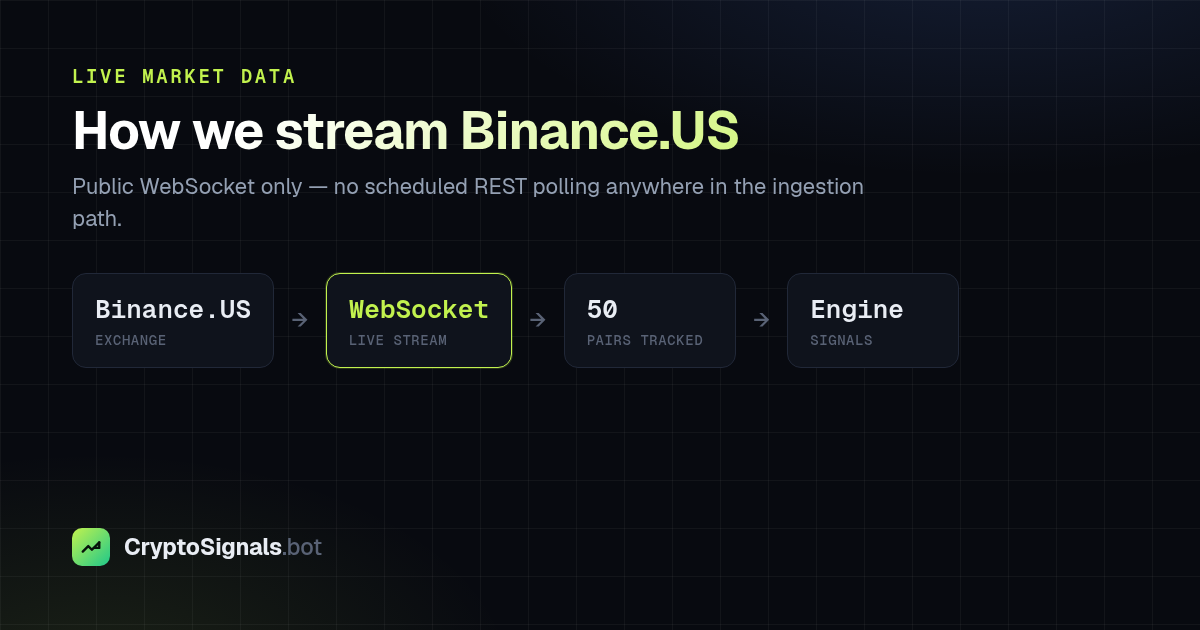
The US-facing venue, streamed live into the CryptoSignals engine over WebSocket — its own order book, its own candles, its own signals.
Binance.US is the United States-facing cryptocurrency exchange, and the detail most often glossed over is the one that matters most for market data: it is a genuinely separate venue from the global Binance.com platform. Separate order book, separate listings, separate liquidity, separate prices. A tick printed on one is not the same tick as a tick printed on the other, and any tool that pretends otherwise will hand you signals that never match the chart in front of you.
CryptoSignals.bot connects to the public Binance.US market-data stream over WebSocket and computes every indicator from those candles and no others. The roster currently runs to roughly fifty trading pairs, split between established majors and a substantial memecoin cohort. This page covers what we track here, how the connection is built, and — equally important — what we deliberately do not do.
40trading pairs tracked
5timeframes computed
WSlive stream, no polling
What Binance.US is, and why we stream it separately
Most of what people want to know about the crypto exchange Binance.US comes down to one question: is Binance available in the US, and does the global platform work there? In market-data terms it resolves cleanly. The US-facing venue is Binance.US, and it is its own exchange — matching its own buyers to its own sellers, listing its own assets, discovering its own prices. Eligibility and regional rules belong to the exchange; its documentation is the only authority there, and we track no account access of any kind.
What we care about is the book. Because this is a distinct market, its candles carry information a global feed does not: the spreads a US participant actually sees, the volume a US session actually prints, and the gaps that open when regional flow diverges from the rest of the world. Computing signals from a relabelled global feed would be faster to build and quietly wrong, so we do not do it.
To be precise about what the venue is to us: a public data source. We are not affiliated with the exchange, and nothing here is an endorsement of trading anywhere.
Coins we track on Binance.US
We currently stream 40 trading pairs from Binance.US. These are the ones our signal engine watches — updated from the live roster, not a static list.
BTCBTCUSDT
ETHETHUSDT
SOLSOLUSDT
XRPXRPUSDT
DOGEDOGEUSDT
ADAADAUSDT
TRXTRXUSDT
AVAXAVAXUSDT
LINKLINKUSDT
DOTDOTUSDT
LTCLTCUSDT
SHIBSHIBUSDT
UNIUNIUSDT
ATOMATOMUSDT
XLMXLMUSDT
NEARNEARUSDT
ALGOALGOUSDT
FILFILUSDT
VETVETUSDT
ICPICPUSDT
HBARHBARUSDT
APTAPTUSDT
ARBARBUSDT
OPOPUSDT
and 16 more pairs tracked on this exchange
How we connect: WebSocket only, no REST polling
Our ingestion rule is strict, and unusual enough to state outright: all market data arrives over WebSocket. There is no scheduled REST polling anywhere in the path. Exactly one REST call is permitted, run once by an administrator, to read the instrument list when a venue is first seeded — never again on a timer.
The reason is data quality rather than etiquette. Polling shows you the market at the instant your timer fired; a stream delivers each candle as the exchange publishes its close. When a signal depends on that close, learning about it forty seconds late is the difference between a signal and a piece of history.
People searching for the Binance.US API usually want one of two things: the public market-data endpoints, or the authenticated trading endpoints. We use only the first. That feed needs no key to read — which keeps a hard wall between reading prices and touching anybody's account.
The connection is supervised rather than trusted: it reconnects with exponential backoff, re-subscribes deliberately instead of assuming a batch succeeded, and verifies that every symbol it asked for is actually delivering. That last check sounds pedantic until you meet a venue that acknowledges a subscription, reports no error, and then streams nothing.
Timeframes and what the signal engine computes
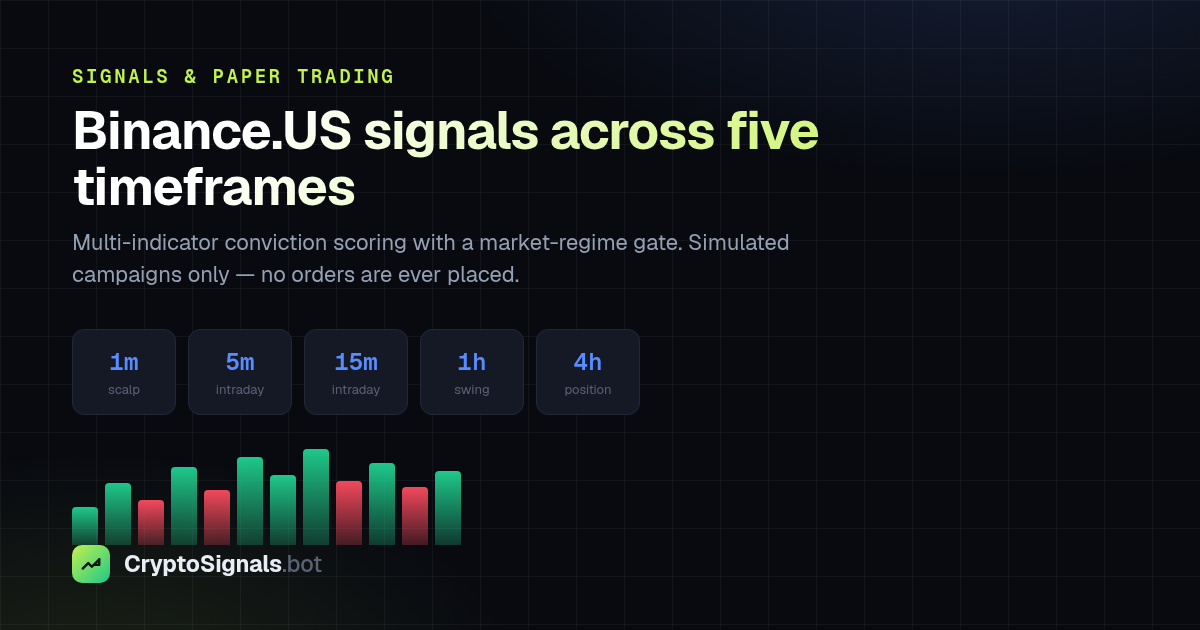
Every pair we follow here is computed across five timeframes: 1 minute, 5 minutes, 15 minutes, 1 hour and 4 hours. That ladder is identical on every exchange we support, which is what lets a signal mean the same thing regardless of which venue produced it — including when you compare this one against the global market.
On top of those candles the engine runs a multi-indicator model spanning trend, momentum, volatility and volume, combining the components into a conviction score rather than firing on a single crossover. A moving-average cross by itself is noise; a cross that agrees with momentum, volume and the prevailing regime is at least worth looking at.
Ahead of all of it sits a market-regime gate. Before any signal is emitted the engine classifies the market it is looking at, because a breakout model that behaves well in a trending market produces a steady drip of failures in a choppy one. Signals carry the regime they were produced under, so they can be read in context rather than as bare verdicts.
Coins and memecoins on the Binance.US roster
The coin grid on this page is not hand-maintained. It is read from our live roster at request time, so it shows what the engine is genuinely watching on the Binance.US cryptocurrency exchange right now, not what somebody typed into a template months ago.
The composition is deliberately two-sided. The majors and established altcoins include BTC, ETH, SOL, XRP, ADA, TRX, AVAX, LINK, DOT, LTC, UNI, ATOM, XLM, NEAR, ALGO and FIL — sixteen names where technical signals behave most predictably, because the books are deeper.
The other side is memecoins, and there are more than twenty of them: DOGE, SHIB, PEPE, BONK, FLOKI, TRUMP, WIF, PENGU, PNUT, PUMP, TOSHI, TURBO, MEW, MOODENG, POPCAT, SPX, BRETT, FARTCOIN, NEIRO and USELESS among them. We track them because our users ask for them, but we treat them as a separate asset class rather than as small altcoins. A memecoin can move thirty percent in an hour on a single headline, and thresholds calibrated on Bitcoin fire almost continuously against that — so memecoins get their own tuning and are reported separately from the majors. Listings change and the roster changes with them: a pair that stops trading is retired automatically rather than lingering as a dead row.
What we do not do: no keys, no logins, no fee quotes
Three things are worth being blunt about, because they are what people ask.
We hold no exchange API keys with trading permission, on this venue or any other. The platform places no orders, cancels no orders and moves no funds. It reads a public price feed and computes indicators — that is the entire surface area.
We never ask for your exchange login. A search for a Binance.US login should end at the exchange's own site and nowhere else; anything claiming to be us and asking for those credentials is not. CryptoSignals.bot accounts are separate, and you need no exchange account to use the simulator.
And we do not quote fees. Binance.US fees are published by the exchange, they change, and they vary by user and order type. A number here that turned out to be a year stale would be worse than none, so we point you at the venue's own schedule.
Paper trading and alerts on Binance.US pairs
Any signal on a Binance.US pair can drive a simulated campaign. You define the rules — which pairs, which timeframes, what conviction threshold, what position sizing — and the engine runs them against the live feed, recording entries, exits and a running tally of gains and losses as though the orders had been placed.
Nothing is executed. That is the core of what CryptoSignals.bot is: a signal simulator and a notification tool. You can watch an idea behave in live market conditions for weeks with no capital at risk and no order ever reaching an exchange. Alerts can be delivered when a campaign fires, so you need not sit in front of a chart — and what you do with one is entirely your own decision.
Binance.US — frequently asked questions
Is Binance available in the US, and is Binance.US the same thing?
They are different exchanges. Binance.US is the US-facing venue with its own order book, listings and prices; Binance.com is a separate global market. We connect to each independently and compute signals from that venue's own candles. Who can open an account where is a question for the exchange itself.
Does CryptoSignals.bot trade on Binance.US for me?
No. We read public market data only. We hold no Binance.US API keys with trading permission and the platform places no orders. Signals and simulated campaigns are informational.
Do I need a Binance.US account or login?
No. Signals and paper trading on these pairs work without any exchange account, because we stream the public market feed rather than anything tied to your account. We never ask for exchange credentials.
What are the Binance.US fees?
We do not publish fee figures. They are set by the exchange, change over time, and vary by user and order type — the venue's own fee schedule is the only reliable source. Our coverage is the market data, not the commercial terms.
Is Binance.US safe?
We are not in a position to rate any exchange's security, solvency or custody arrangements, and our coverage of a venue should not be read as a verdict on it. Listing an exchange here means we read its public price feed — nothing more.
Which coins does the engine track here?
The grid above is generated live from our roster and mixes majors such as BTC, ETH, SOL and XRP with a memecoin cohort of more than twenty tickers. It updates as listings and liquidity change.
Is this financial advice?
No. CryptoSignals.bot is a signal simulator and alerting tool. Nothing on this page or anywhere in the product is a recommendation to buy or sell any asset. Crypto trading carries substantial risk, including the total loss of the money involved.