KuCoin crypto exchange — live market data and signal coverage
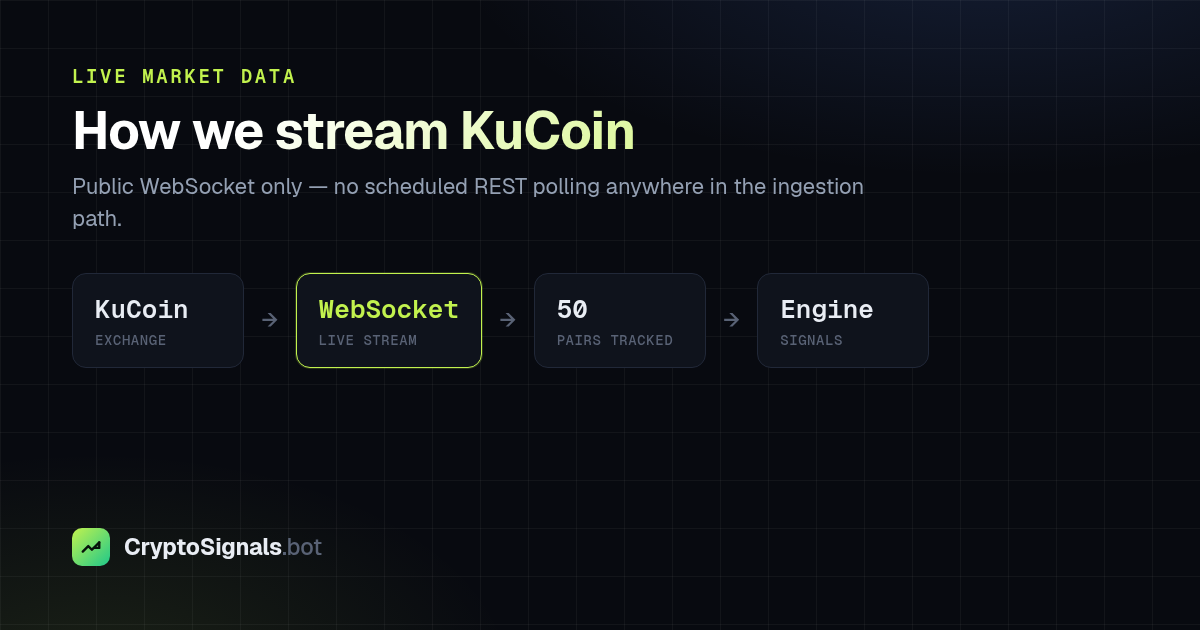
A broad-listing global venue, streamed live into the CryptoSignals engine over WebSocket — 50 pairs, five timeframes, zero orders placed.
KuCoin is a global cryptocurrency exchange with a reputation for breadth. Alongside the majors it lists a long tail of smaller tokens, many of which appear there well before they reach more conservative venues. For a signal platform that breadth is the interesting part: the same technical model can be pointed at Bitcoin and at a token with a fraction of its liquidity, and the difference in how the two behave is itself information.
CryptoSignals.bot connects to the public KuCoin market-data WebSocket and reads candles as the exchange publishes them. We stream a live roster from this venue — the current count is in the band above and the grid below — with a substantial memecoin share. This page sets out what we track on the KuCoin crypto exchange, how the connection works, and what the signal engine does with the data. It also says clearly what we are not: we are not KuCoin, we are not affiliated with KuCoin, and we place no orders anywhere.
50trading pairs tracked
23memecoins tracked
5timeframes computed
WSlive stream, no polling
What KuCoin is, and why we stream it
KuCoin is a centralised spot exchange serving a worldwide user base, and it is best understood by what it chooses to list. Where some venues keep a tight, curated book, KuCoin runs wide — majors, mid-cap alts and a deep bench of newer, more speculative tokens all trade side by side.
That makes it a different data source from venues carrying only the top of the market. An engine fed exclusively on Bitcoin and Ethereum learns one kind of market: deep, slow-moving, heavily arbitraged. Add a KuCoin roster and it also sees thin books, sharp gaps and volume arriving in bursts. Both are real markets, and modelling only the comfortable one produces a system that breaks when it meets the other.
The second reason is architectural. KuCoin publishes market data on a public, unauthenticated feed, so reading prices requires no API key at all. There is no credential anywhere in our system that could place an order on this exchange even if something went badly wrong. KuCoin is a data source to us and nothing more — describing what trades on a venue is not an endorsement of trading there.
Coins we track on KuCoin
We currently stream 50 trading pairs from KuCoin. These are the ones our signal engine watches — updated from the live roster, not a static list.
BTCBTC-USDT
ETHETH-USDT
SOLSOL-USDT
XRPXRP-USDT
DOGEDOGE-USDT
ADAADA-USDT
TRXTRX-USDT
AVAXAVAX-USDT
LINKLINK-USDT
DOTDOT-USDT
LTCLTC-USDT
SHIBSHIB-USDT
UNIUNI-USDT
ATOMATOM-USDT
XLMXLM-USDT
NEARNEAR-USDT
ALGOALGO-USDT
FILFIL-USDT
VETVET-USDT
ICPICP-USDT
HBARHBAR-USDT
APTAPT-USDT
ARBARB-USDT
OPOP-USDT
and 26 more pairs tracked on this exchange
How we connect: WebSocket only, no REST polling
Our ingestion rule is strict and worth stating plainly, because it is unusual: all market data arrives over WebSocket. Nothing in the pipeline polls a REST endpoint on a schedule. A single REST call is permitted once, run by an administrator, to seed the instrument list when an exchange is first brought online — and never again on a timer. KuCoin adds one wrinkle of its own: it publishes no fixed public WebSocket address, so a short-lived connection token is fetched over a single unauthenticated request each time the stream connects or reconnects. That request carries no credentials and no market data — it only tells the client where to point the socket. No candle ever reaches us over REST.
The motivation is data quality as much as politeness to the venue. Polling hands you whatever the market looked like at the instant your timer fired; a stream hands you every candle at the moment it closes. When a rule depends on the close of a five-minute bar, learning about it forty seconds late is the difference between a signal and a piece of history.
The connection is supervised rather than trusted. It reconnects with exponential backoff, re-subscribes deliberately instead of assuming a batch request succeeded, and verifies that every symbol it asked for is actually delivering candles. Exchanges have accepted a subscription, acknowledged it, reported no error and then silently streamed nothing for part of the list — which is why a pair that goes quiet raises an alarm here instead of vanishing from the analysis unnoticed.
Timeframes and what the signal engine computes
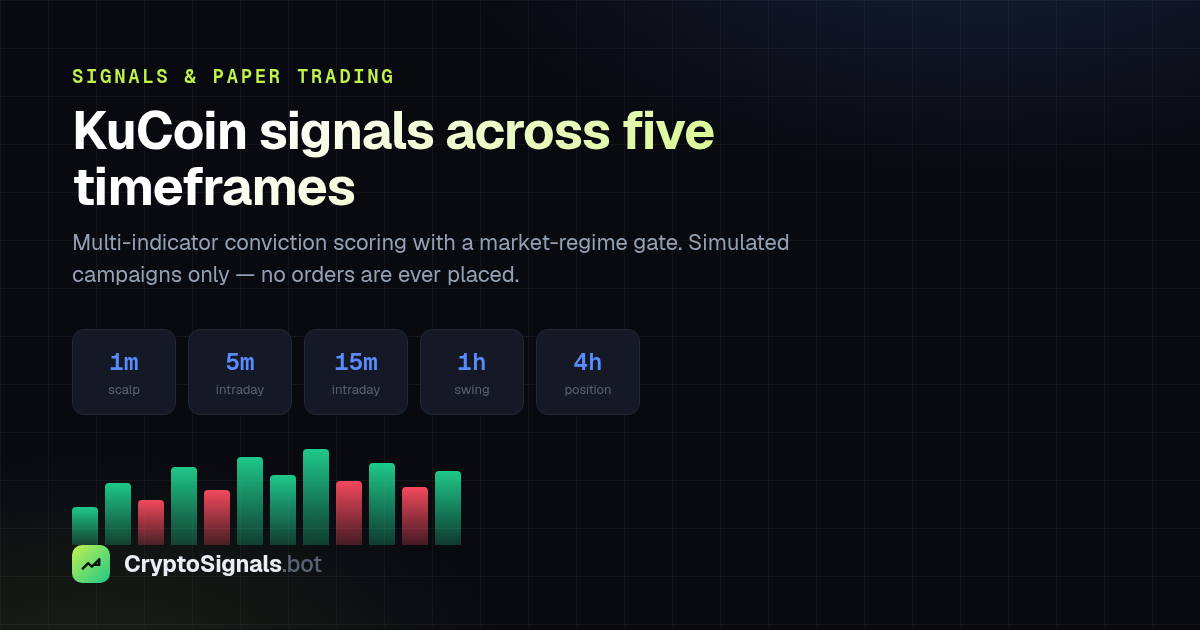
Every KuCoin pair we track is computed across five timeframes: 1 minute, 5 minutes, 15 minutes, 1 hour and 4 hours. That ladder is identical on every venue we support, which is deliberate — a signal should mean the same thing whether the candles came from KuCoin or from anywhere else, so nothing about the interpretation changes when you switch exchanges.
On top of those candles the engine runs a multi-indicator model covering trend, momentum, volatility and volume, and combines the components into a conviction score instead of firing on any single crossover. A moving-average cross by itself is noise; a cross that agrees with momentum, with volume and with the prevailing state of the market is worth surfacing. That score is what you see, and what campaign thresholds are set against.
Before anything is emitted there is a market-regime gate. The engine first asks what kind of market it is looking at, because a breakout rule that reads well in a trending market produces a steady drip of losses in a choppy one. Signals carry the regime they were generated under, so they can be judged in context — and on a venue where a quiet mid-cap and a token in a mania phase sit in the same roster, that gate does a lot of work.
Majors, altcoins and memecoins on KuCoin
The coin grid on this page is not hand-maintained copy. It is read from our live roster every time the page is requested, so it shows what the engine is watching on the KuCoin cryptocurrency exchange right now rather than what was true when someone last edited a file.
Of the 50 pairs we stream here, the majors and established altcoins include BTC, ETH, SOL, XRP, ADA, TRX, AVAX, LINK, DOT, LTC, UNI, ATOM, XLM, NEAR, ALGO and FIL. These are the pairs where classical technical analysis behaves most predictably, because the books are deeper and the participants more numerous.
Twenty-three of the pairs are memecoins, and we treat those as a distinct asset class rather than as unusually small altcoins. The cohort includes DOGE, SHIB, PEPE, BONK, FLOKI, WIF, BOME, PENGU, PNUT, TURBO and GOAT. A memecoin can move tens of percent in an hour on nothing but a post, and thresholds calibrated on Bitcoin fire almost continuously against that. So memecoins get their own tuning, and their results are reported separately from the majors rather than averaged into them.
One of the most common searches we see here is KuCoin Shiba Inu. SHIB is on our roster and handled under the memecoin model above, which gets you coverage: candles, indicators, conviction scores, alerts, simulated positions. What it does not get you is a recommendation — we do not tell anyone to buy or sell SHIB or anything else, and we hold no keys that could act on it.
Logins, verification and US availability — read this first
Many searches around this exchange are account questions: KuCoin login, KuCoin verification, whether KuCoin is available in the US. We would rather answer those honestly than quietly collect the traffic. We are not KuCoin and cannot help with your exchange account — we cannot reset a password, unlock a login, progress a verification review, recover funds or answer anything about fees. Those belong with the exchange, reached from its own site. Note also that account-recovery scams cluster around exactly these searches: nobody legitimate needs your seed phrase or your two-factor codes.
On regional availability, including the US: eligibility rules for centralised exchanges change with regulation and vary by jurisdiction, and we are not in a position to state anyone's current status. Check the exchange directly.
None of it gates CryptoSignals.bot, though. Because we read the public market feed rather than your account, our KuCoin coverage — signals, alerts, paper trading — works whether or not you hold an account on the venue.
Paper trading and alerts on KuCoin pairs
Any signal on a KuCoin pair can drive a simulated campaign. You define the rules — which pairs, which of the five timeframes, what conviction threshold, what position sizing — and the engine runs them against the live stream, recording entries, exits and a running tally of gains and losses exactly as though the orders had been placed.
They are not placed. That is the whole point of the product: CryptoSignals.bot is a signal simulator and a notification tool. You can watch a strategy behave in real conditions for weeks, across a quiet stretch and a violent one, before forming any view on it — with no capital exposed at any stage.
A broad venue is a useful place to do that: running one ruleset on a KuCoin major and a KuCoin memecoin side by side, under identical settings, is more instructive than any amount of reading about it. Alerts can be delivered when a campaign fires, so you are not tied to a chart. What you do with an alert is entirely your own decision.
KuCoin — frequently asked questions
Does CryptoSignals.bot trade on KuCoin for me?
No. We read public market data only. We hold no KuCoin API keys with trading permission and the platform places no orders on any venue. Signals and simulated campaigns are informational.
Do I need a KuCoin account to use CryptoSignals.bot?
No. Our coverage is built on the public market feed, not on your account, so signals, alerts and paper trading on KuCoin pairs work without an exchange account of any kind.
Can you help with my KuCoin login or verification?
No — we are not the exchange and have no access to accounts, balances or verification queues. Those belong with KuCoin support via its own site. Never share a seed phrase, password or two-factor code with anyone claiming they can fix it for you.
Is this a KuCoin exchange review?
No. This page describes what we stream from the venue and how our engine processes it. We do not rank exchanges, rate them or advise anyone on where to trade.
Which KuCoin coins does the engine track?
Fifty pairs at present, 23 of them memecoins and the rest majors and established altcoins. The grid above is generated live from our roster, so a pair that stops trading is retired rather than left as a dead entry.
How fast is the data?
It arrives over a live WebSocket stream as KuCoin publishes each candle. We do not poll on a timer, so there is no fixed refresh interval between a bar closing and the engine seeing it.
Is this financial advice?
No. CryptoSignals.bot is a signal simulator and alerting tool. Nothing on this page or in the product is a recommendation to buy or sell any asset, and no outcome is promised or implied. Crypto trading carries substantial risk, including total loss of the amount involved.