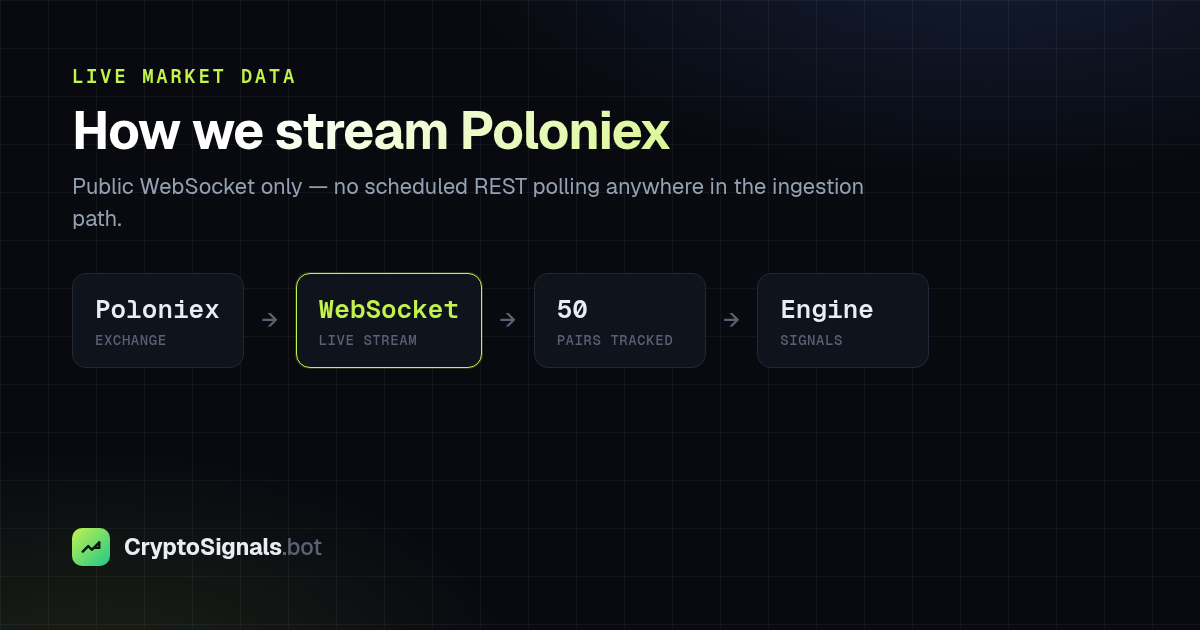
One of the longer-running names in crypto trading, streamed live into the CryptoSignals engine over WebSocket.
Poloniex is one of the longer-running names in cryptocurrency trading, and the part that matters for our purposes is simple: it runs its own spot order book, and that order book prints its own prices. For a signal engine, an independent book is the whole point — a price that is genuinely formed on this venue, by the people trading on it, rather than mirrored in from somewhere else and relabelled.
CryptoSignals.bot connects to the public Poloniex market-data feed over WebSocket and computes indicators on the candles as they close. We do not place orders, we hold no trading credentials, and we are not affiliated with the exchange. This page sets out exactly what we watch on Poloniex, how the connection is built, and what the engine does with what it sees.
50trading pairs tracked
5timeframes computed
WSlive stream, no polling
What Poloniex is, and why we stream it
Poloniex is a spot cryptocurrency exchange with a long history in the altcoin market. Traders who have been through more than a cycle or two tend to recognise the name immediately.
We stream it for two reasons. The first is independence. Every exchange we connect to has its own book, its own participants and its own liquidity profile, so the same asset can be trending on one venue and going nowhere on another. A signal computed from Poloniex candles describes what happened on Poloniex — which is what a trader looking at a Poloniex chart actually needs.
The second is coverage. The roster we run here mixes established majors with a substantial memecoin tail, and that combination is exactly what our users ask us to watch. As with every venue on this site, it is worth being precise about the relationship: to us the Poloniex exchange is a public data source. We read prices from it. We do not sell its services, endorse trading on it, or hold any account there on your behalf.
Coins we track on Poloniex
We currently stream 50 trading pairs from Poloniex. These are the ones our signal engine watches — updated from the live roster, not a static list.
BTCBTC_USDT
ETHETH_USDT
SOLSOL_USDT
XRPXRP_USDT
DOGEDOGE_USDT
ADAADA_USDT
TRXTRX_USDT
AVAXAVAX_USDT
LINKLINK_USDT
DOTDOT_USDT
LTCLTC_USDT
SHIBSHIB_USDT
UNIUNI_USDT
ATOMATOM_USDT
XLMXLM_USDT
NEARNEAR_USDT
FILFIL_USDT
ICPICP_USDT
APTAPT_USDT
ARBARB_USDT
OPOP_USDT
SUISUI_USDT
PEPEPEPE_USDT
ETCETC_USDT
and 26 more pairs tracked on this exchange
How we connect: WebSocket only, no REST polling
Our ingestion rule is strict, and it is unusual enough to state plainly: all market data arrives over WebSocket. There is no scheduled REST polling anywhere in the path. A single REST call is permitted once, run by an administrator, to read the instrument list when a venue is first seeded — and never again on a timer.
This is a data-quality decision before it is a politeness one. Polling hands you whatever the market looked like at the instant your timer fired; a stream hands you every candle as the exchange publishes its close. When a rule depends on the close of a five-minute bar, learning about it thirty seconds late is not a slower signal, it is a different one.
The connection is supervised rather than trusted. It reconnects with exponential backoff, re-subscribes deliberately instead of assuming a batched request succeeded, and then verifies that every symbol it asked for is genuinely delivering data. That last check sounds pedantic until you have met a venue that accepts a subscription, acknowledges it, reports no error and quietly streams nothing for a third of your list. We have. The check exists because of it, and it runs on every exchange, Poloniex included.
Timeframes and what the signal engine computes
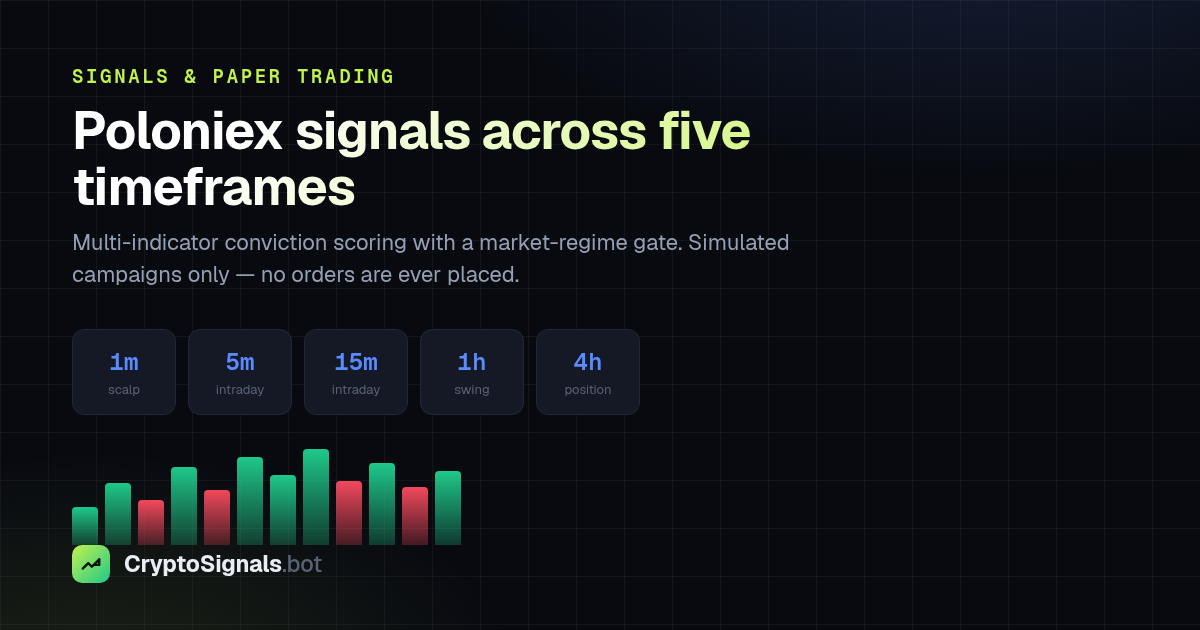
Every Poloniex pair we track is computed across five timeframes: 1 minute, 5 minutes, 15 minutes, 1 hour and 4 hours. The same ladder runs on every venue we support, which means a signal carries the same meaning whichever exchange produced it — no venue gets a special shortcut or a coarser resolution because it is smaller.
On top of those candles the engine runs a multi-indicator model covering trend, momentum, volatility and volume, then combines the components into a conviction score instead of firing on any single crossover. A moving-average cross on its own is close to noise. A cross that agrees with momentum, is confirmed by volume and sits inside a supportive market regime is worth putting in front of a person.
That last clause is a real gate, not a figure of speech. Before any signal is emitted the engine classifies the prevailing market regime, because a breakout rule that behaves well in a trending market produces a steady drip of failures in a choppy one. Signals are labelled with the regime they fired under, so you can read them in context rather than as context-free arrows on a chart.
Majors and memecoins on the Poloniex roster
The coin grid above is not a hand-maintained list. It is read from our live roster at the moment this page is requested, so it shows what the engine is actually watching on Poloniex right now — fifty pairs at the time of writing, and a number that moves as listings and liquidity move.
The majors side covers the assets most people build a watchlist around: BTC, ETH, SOL, XRP, ADA, TRX, AVAX, LINK, DOT, LTC, UNI, ATOM, XLM, NEAR, FIL and ICP. These are the pairs where classical technical signals behave most predictably, because the books are deeper and the participants more numerous.
The rest of the roster is memecoins, twenty-three of them, and we treat that as a separate asset class rather than as a set of small altcoins. DOGE, SHIB, PEPE, BONK, FLOKI, WIF, BOME, TURBO, POPCAT, MEW, GOAT, MOODENG, DEGEN, TOSHI and their cohort do not move the way ETH moves. A memecoin can travel thirty percent in an hour on a single headline, and indicator thresholds calibrated on Bitcoin fire constantly against that kind of price action. So memecoin pairs get their own tuning, their own thresholds, and they are reported separately from the majors instead of being averaged into the same view.
Why a venue's own order book matters
It is tempting to assume a coin has one price and every exchange shows a slightly stale copy of it. In practice each venue has its own book, its own depth and its own flow, and can lag, lead or simply diverge from the largest ones for minutes at a time. Thinner books also mean a single order moves price further, which changes how volume and volatility indicators read.
We handle that the honest way: one connection per exchange, one roster per exchange, signals computed strictly from that venue's own candles. If you follow a pair on the Poloniex exchange you get Poloniex candles, never a global feed relabelled with a Poloniex badge. The alternative would produce signals that never quite matched the chart in front of you, and a signal you cannot reconcile with your own screen is worse than no signal at all.
It also makes cross-venue comparison meaningful. Because the timeframe ladder and the scoring model are identical everywhere, you can watch the same asset on Poloniex and on a larger venue and see, genuinely, where the two disagree.
Paper trading and alerts on Poloniex pairs
Any signal on a Poloniex pair can drive a simulated campaign. You define the rules — which pairs, which timeframes, what conviction threshold, how positions are sized — and the engine runs them against live market data, recording entries, exits and a running profit-and-loss as though the trades had been placed.
Nothing is executed. That is the core of what this product is: a signal simulator and an alerting tool. You can let a strategy run in real market conditions for weeks and form your own view about it without a single unit of capital at risk. Simulated results describe the past behaviour of a rule set on recorded data; they are not a forecast and they are not a promise.
Alerts can be delivered when a campaign fires, so you are not tied to a chart. What you do after an alert arrives is entirely your own decision, taken on your own account, on whatever venue you choose.
Poloniex — frequently asked questions
Does CryptoSignals.bot trade on Poloniex for me?
No. We read public market data only. We hold no Poloniex API keys with trading permission and the platform places no orders anywhere. Signals and simulated campaigns are informational.
Do I need a Poloniex account to use CryptoSignals.bot?
No. Signals and paper trading on Poloniex pairs work without any exchange account, because we stream the public market feed rather than reading anything belonging to you.
Which Poloniex coins does the engine track?
Fifty pairs at present, generated live from our roster — sixteen majors and twenty-three memecoins, plus the remainder of the list. It changes as listings and liquidity change: a pair that stops trading is retired rather than left on the page as a dead entry.
Are Poloniex prices the same as prices on a larger exchange?
Not exactly. Every venue runs its own order book, so quotes and candles can differ, sometimes materially during fast moves. We compute Poloniex signals from Poloniex data only, so what you see matches the venue you are looking at.
How fast is the data?
It arrives over a live WebSocket stream as the exchange publishes each candle. There is no polling timer in the path, so there is no fixed refresh delay between a bar closing and the engine seeing it.
Why are memecoins handled differently?
Because their volatility profile is different in kind, not just in degree. Thresholds tuned on majors misfire against moves of tens of percent in an hour, so memecoins carry their own tuning and are reported as a separate class.
Is this financial advice?
No. CryptoSignals.bot is a signal simulator and alerting tool. Nothing on this page or in the product is a recommendation to buy or sell any asset, and no result is promised or implied. Crypto trading carries substantial risk, including total loss of the amount involved.