Bybit crypto exchange — live market data and signal coverage
A derivatives-first exchange with deep spot liquidity, streamed live into the CryptoSignals engine over WebSocket.
Bybit is one of the venues traders reach for when they want depth rather than breadth. It built its reputation on derivatives and carries a serious spot book alongside them, which means its candles on the majors are dense, continuous and rarely full of the gaps that make technical indicators misbehave. For a signal engine, that is the whole argument for connecting to a venue.
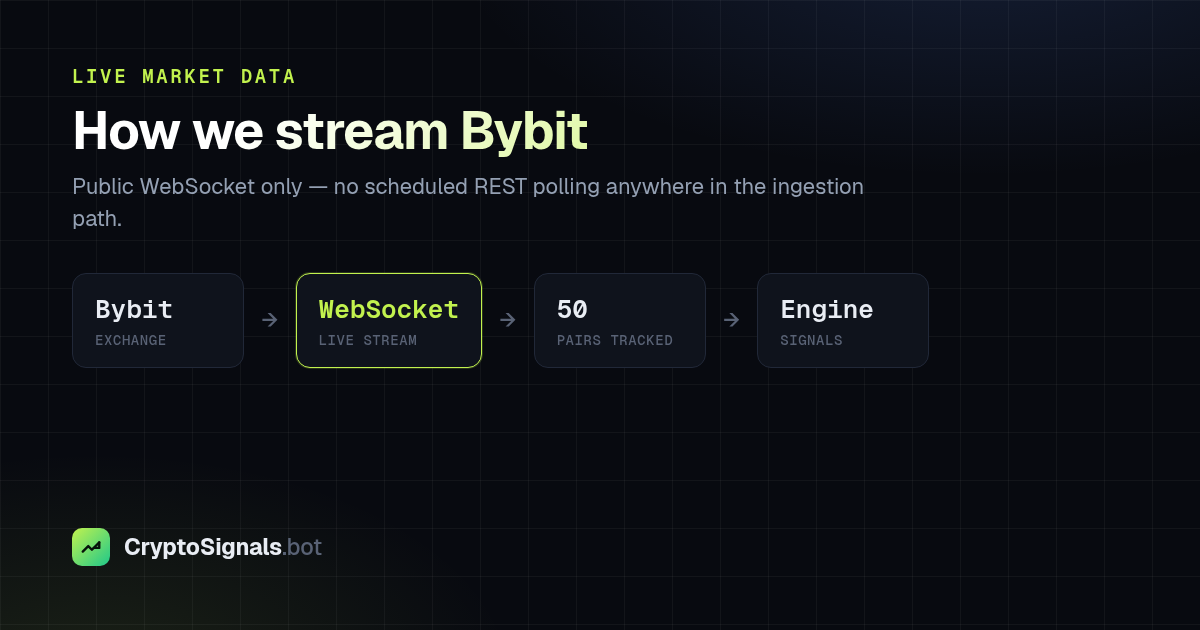
CryptoSignals.bot streams 50 Bybit trading pairs straight from the exchange's public WebSocket feed and computes indicators on every candle as it closes. We do not poll a REST endpoint on a timer, we do not buy a repackaged third-party feed, and we do not place orders. This page sets out exactly what we watch on the Bybit crypto exchange, how the connection is built, and what the engine does with the data once it arrives.
50trading pairs tracked
5timeframes computed
WSlive stream, no polling
What is Bybit, and why we stream it
People searching for what is Bybit usually get one of two unhelpful answers: a marketing page, or an affiliate review with a sign-up button at the bottom. Here is the plain version from the perspective of someone who reads its market data all day. Bybit is a large international cryptocurrency exchange best known for perpetual futures and other derivatives, with a spot market that has grown into a genuine price-discovery venue in its own right.
That character shows up in the data. Active venues produce tight, well-populated candles with continuous volume, which is what turns a volume-confirmed breakout from a coincidence into something measurable. Thin venues produce the opposite — long flat stretches punctuated by a single print that drags an indicator sideways for an hour.
It is worth being precise about what Bybit is to us: a data source, nothing more. We are not affiliated with the exchange, we do not resell its services, and nothing on this page is an endorsement of trading there or anywhere else. We read public prices and compute indicators on them.
Coins we track on Bybit
We currently stream 50 trading pairs from Bybit. These are the ones our signal engine watches — updated from the live roster, not a static list.
BTCBTCUSDT
ETHETHUSDT
SOLSOLUSDT
XRPXRPUSDT
DOGEDOGEUSDT
ADAADAUSDT
TRXTRXUSDT
AVAXAVAXUSDT
LINKLINKUSDT
DOTDOTUSDT
LTCLTCUSDT
SHIBSHIBUSDT
UNIUNIUSDT
ATOMATOMUSDT
XLMXLMUSDT
NEARNEARUSDT
ALGOALGOUSDT
FILFILUSDT
VETVETUSDT
ICPICPUSDT
HBARHBARUSDT
APTAPTUSDT
ARBARBUSDT
OPOPUSDT
and 26 more pairs tracked on this exchange
How we connect: WebSocket only, no REST polling
Our market-data rule is strict, and unusual enough to state plainly: all market data arrives over WebSocket. There is no scheduled REST polling anywhere in the ingestion path. Exactly one REST call is permitted, run once by an administrator, to read the instrument list when an exchange is first seeded — and never on a timer afterwards.
The reason is data quality as much as good manners toward the venue. Polling hands you a snapshot taken at whatever instant your timer happened to fire. A stream hands you every candle at the moment the exchange publishes its close. When a signal depends on the close of a 5-minute bar, learning about it forty seconds late is the difference between a signal and a piece of history.
The connection is supervised rather than trusted. It reconnects with exponential backoff, it re-subscribes deliberately instead of assuming a batch subscription succeeded, and it verifies that every symbol it asked for is genuinely delivering candles. That last check sounds like paranoia until you meet an exchange that accepts a subscription, acknowledges it, reports no error and then quietly streams nothing for a subset of symbols. We have met one — the check exists because of it, and it runs on Bybit exactly as everywhere else.
Timeframes and what the signal engine computes
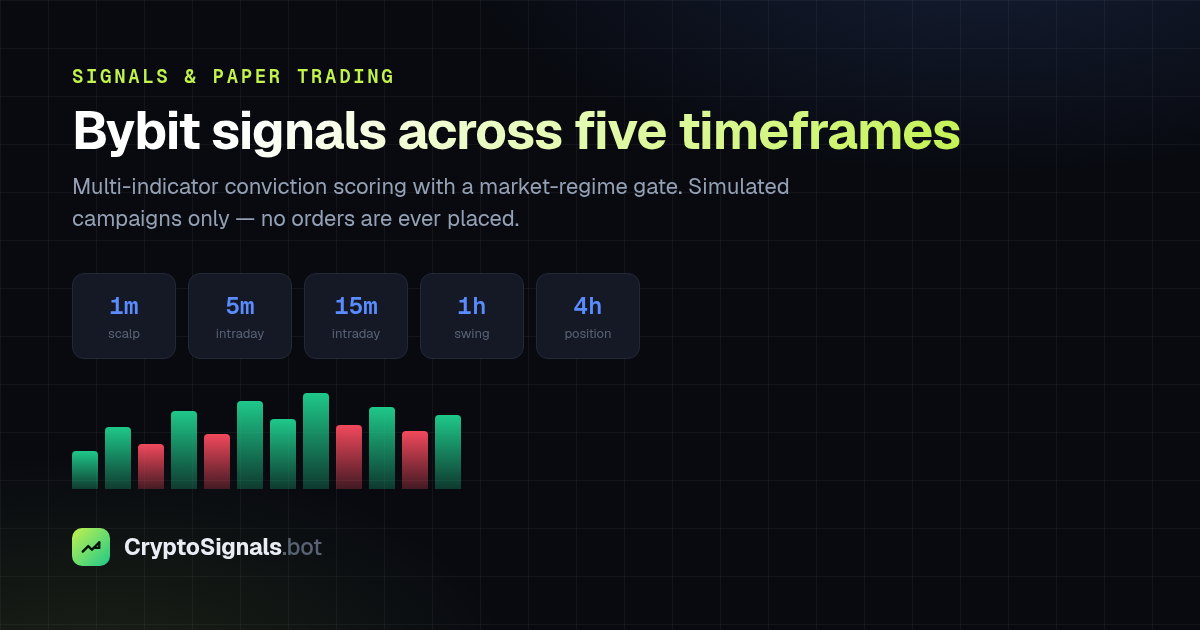
Every pair we track on Bybit is computed across five timeframes: 1 minute, 5 minutes, 15 minutes, 1 hour and 4 hours. The same ladder applies on every exchange we support, so a signal carries the same meaning whichever venue produced it — no venue gets a shorter ladder because its feed was easier to wire up.
On top of those candles the engine runs a multi-indicator model covering trend, momentum, volatility and volume, and combines the components into a single conviction score instead of firing on any one crossover. A moving-average cross by itself is noise. A cross that agrees with momentum, is confirmed by volume, and sits in a market regime where that behaviour historically means something is worth putting in front of a person.
Before anything is emitted there is a market-regime gate. The engine first asks what kind of market it is looking at — trending, ranging, volatile — because a breakout model that reads well in a trend produces a steady drip of failures in chop. Signals are tagged with the regime they were produced under, so you can judge them in context rather than as a bare buy-sell label. They are not buy-sell labels, and we are careful never to present them as such.
Majors, altcoins and memecoins on Bybit
The coin grid above is not a hand-maintained list. It is read from our live roster every time this page is requested, so it reflects what the engine is actually watching on Bybit at this moment rather than what someone typed into a file last quarter.
The mix is deliberate. The majors and established altcoins side covers Bitcoin, Ethereum, Solana, XRP, Cardano, TRON, Avalanche, Chainlink, Polkadot, Litecoin, Uniswap, Cosmos, Stellar, NEAR, Algorand and Filecoin. These are the pairs where technical signals behave most predictably, because the books are deep, the participants are many and a single order rarely moves the tape.
Twenty-three of the pairs are memecoins — DOGE, SHIB, PEPE, BONK, FLOKI, TRUMP, WIF, BOME, PENGU, PNUT, PUMP, TOSHI, CATI, DEGEN, DOGS, GOAT, HMSTR, LUNC, MEW, PEOPLE and others. We carry them because users ask for them, but we treat them as a separate asset class with their own statistics rather than as small altcoins. A memecoin can move tens of percent in an hour on a single social-media post; indicator thresholds calibrated on Bitcoin fire almost continuously against that kind of price action. Memecoin pairs therefore get their own tuning, and their results are reported separately from the majors so one cohort never quietly flatters the other.
Bybit login, Bybit USA, and what we never touch
A lot of the traffic around this exchange is people looking for the Bybit login page, checking whether Bybit is available where they live, or hunting for a referral code. None of that is us, and it is worth saying so directly rather than leaving it ambiguous.
CryptoSignals.bot is an independent signal simulator. We have no partnership, affiliate arrangement or referral relationship with Bybit, we do not host or proxy anyone's sign-in, and we cannot help with account access, verification or withdrawals — those belong to the exchange's own support channels. Whether Bybit serves users in a given country, Bybit USA questions included, is a matter for the exchange and your local regulator; it changes over time, and we neither track it nor guess at it here.
Nor do we ever see your Bybit wallet. The market-data feed we consume is public and unauthenticated: it contains prices and volumes, not accounts. We hold no exchange API keys with trading permission, so there is no path from our infrastructure to your balance even in principle. If you are weighing up the honest pros and cons of a data-only service, that is the significant one on both sides of the ledger — nothing we run can touch your funds, and equally, nothing we run can act for you.
Paper trading and alerts on Bybit pairs
Any signal on a Bybit pair can drive a simulated campaign. You define the rules — which pairs, which timeframes, what conviction threshold, what position sizing — and the engine runs them against the live feed, recording entries, exits and a running P&L exactly as though the orders had been placed.
Nothing is executed. That is the centre of what CryptoSignals.bot is: a signal simulator and an alerting tool. You can watch a set of rules behave in real market conditions for weeks, across trending and choppy regimes alike, before forming any view about it — with no capital at risk while you do. We also do not model leverage, funding or liquidation mechanics, so simulated results describe indicator behaviour on price, not the economics of a leveraged position.
Alerts can be delivered when a campaign fires, so you are not tied to a chart. What you do with an alert, on Bybit or anywhere else, is entirely your own decision.
Bybit — frequently asked questions
Does CryptoSignals.bot trade on Bybit for me?
No. We read public market data only. We never hold Bybit API keys with trading permission, and the platform places no orders of any kind. Signals and simulated campaigns are informational.
Do I need a Bybit account to use CryptoSignals.bot?
No. Signals and paper trading on Bybit pairs work without any exchange account, because we stream the public market feed rather than your account data. Your CryptoSignals login is entirely separate from any exchange sign-in.
Which Bybit coins does the engine track?
Fifty pairs at present, generated live from our roster above: sixteen majors and established altcoins, a memecoin cohort of twenty-three, and the remainder of the list. The list changes as listings and liquidity change — a pair that stops trading is retired automatically rather than lingering as a dead entry.
Are you affiliated with Bybit? Do you have a Bybit referral code?
No to both. We have no affiliate, referral or partnership arrangement with the exchange, and we do not publish invite codes. We consume a public data feed, which requires no relationship with the venue at all.
Can I use this if Bybit is not available in my region?
Our coverage of Bybit market data does not depend on you having access to the exchange, since the feed is public. But we cannot advise on regional availability or eligibility — that is a question for Bybit and for the rules that apply where you live.
Do you track Bybit derivatives, leverage or funding rates?
The engine computes the same indicator ladder on the pairs in our roster and does not model leverage limits, funding payments or liquidation mechanics. For the current rules on any leveraged product, check the exchange directly — we do not republish those figures.
Is this financial advice?
No. CryptoSignals.bot is a signal simulator and alerting tool. Nothing on this page or in the product is a recommendation to buy or sell any asset, and no outcome is promised or implied. Crypto trading carries substantial risk, including total loss of capital.